
As climate change accelerates, the consequences are no longer distant forecasts—they’re financial realities hitting homeowners across the United States. In 2025, home insurance premiums in coastal states have skyrocketed, reflecting the mounting risks of hurricanes, floods, and rising sea levels.
From Florida to California, and the Carolinas to Texas, insurers are recalculating their risk models—and for millions of homeowners, that means higher costs, stricter coverage limits, or no coverage at all.
This surge in premiums isn’t just a short-term spike. It marks a fundamental shift in how the insurance industry assesses climate-related risks—and how homeowners must adapt to a new era of climate-influenced housing economics.
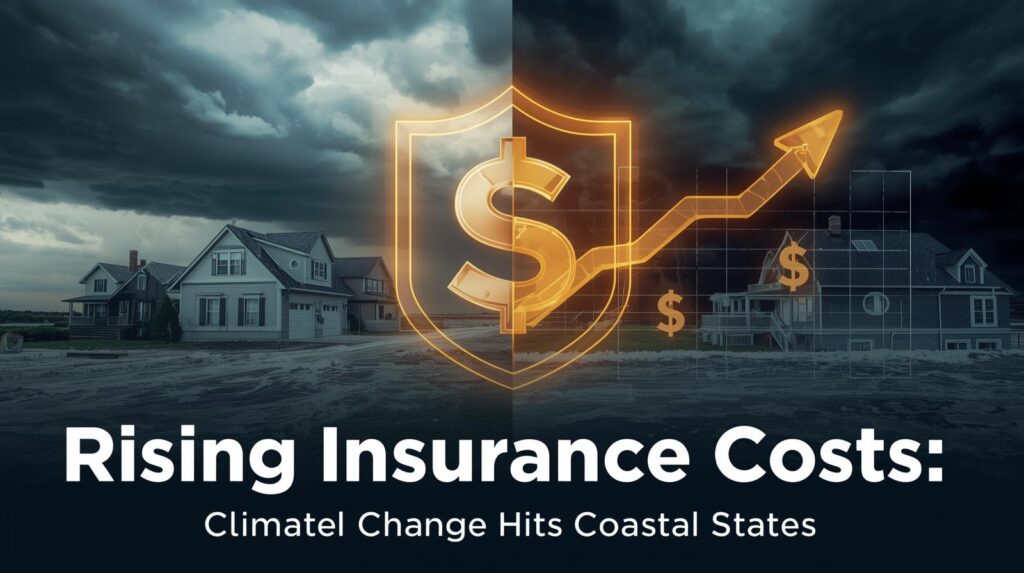
1. The Perfect Storm: Why Home Insurance Premiums Are Rising
Over the past decade, the frequency and severity of natural disasters have increased dramatically. The National Oceanic and Atmospheric Administration (NOAA) reports that the U.S. experienced more billion-dollar weather and climate disasters in 2024 than in any previous year on record.
Insurers, overwhelmed by mounting claims from hurricanes, wildfires, and floods, are adjusting premiums to reflect the true cost of climate exposure.
In 2025, many coastal states have seen premium increases exceeding 30–50%, with some insurers withdrawing entirely from high-risk areas.
Key Drivers Behind Rising Costs:
- More intense hurricanes and storms leading to catastrophic damage
- Coastal flooding and sea-level rise threatening property values
- Wildfire risks spreading beyond traditional zones
- Reinsurance costs surging as global insurers price in climate risk
- Updated risk models that factor in long-term climate projections
The result? A widening affordability gap in homeownership—especially for middle-class families in vulnerable regions.
2. The Hardest-Hit Regions in the U.S.
While climate change impacts every state, certain coastal regions are bearing the brunt of premium increases and insurer pullouts.
a. Florida: Ground Zero for Insurance Volatility
Florida homeowners have seen some of the steepest insurance hikes in the nation.
With hurricane seasons growing longer and more destructive, several major insurers have either reduced exposure or left the state entirely.
According to the Florida Office of Insurance Regulation, average home insurance premiums have tripled since 2019, reaching more than $6,000 annually—nearly four times the national average.
Residents increasingly rely on Citizens Property Insurance, the state-run “insurer of last resort.”
b. California: Wildfires Reshape the Insurance Map
In California, wildfires have replaced hurricanes as the dominant threat.
As megafires destroy thousands of homes annually, insurers are tightening underwriting standards, raising deductibles, or refusing to renew policies in high-risk ZIP codes.
Despite regulatory efforts to stabilize premiums, many homeowners have turned to the California FAIR Plan, an emergency coverage option with limited benefits.
c. Gulf Coast & Southeastern States
Texas, Louisiana, and the Carolinas face dual threats—hurricanes and flood risk.
Even inland areas are seeing rate increases due to heavier rainfall and aging drainage infrastructure.
The combination of storm surge and property growth in coastal zones has made the Gulf Coast one of the most expensive insurance markets in America.
3. The Role of Climate Change in Insurance Risk Models
Historically, insurers relied on backward-looking data—past claims, historical weather trends, and static maps. But the climate crisis has made these models obsolete.
Now, insurers are integrating forward-looking climate models, which simulate how rising sea levels, warmer oceans, and shifting storm paths affect risk in the coming decades.
This shift means:
- Areas previously considered “safe” may now be reclassified as high-risk.
- Long-term exposure is being priced in, not just immediate threats.
- Reinsurance markets (which protect insurers themselves) are charging more for climate-related coverage.
In essence, the insurance industry is acknowledging that climate change isn’t a temporary anomaly—it’s a structural risk factor.
4. The Reinsurance Ripple Effect
Reinsurers—global companies that insure insurers—play a crucial behind-the-scenes role in determining premium costs.
As climate disasters multiply, reinsurers like Swiss Re and Munich Re have raised their prices, citing historic payout levels.
These costs cascade down to consumers, as primary insurers pass on higher reinsurance expenses to homeowners.
In 2025, many reinsurers have also tightened underwriting criteria, refusing to back policies in the most vulnerable ZIP codes.
This has forced some U.S. insurers to reduce coverage options, increase deductibles, or exit states altogether.
5. The Economic Fallout for Homeowners
For millions of Americans, the rise in home insurance premiums is more than a financial inconvenience—it’s a threat to housing stability.
a. Shrinking Affordability
Homeownership is becoming harder to sustain in high-risk regions.
Mortgage lenders typically require active insurance, meaning families unable to afford skyrocketing premiums may struggle to keep their homes.
b. Real Estate Market Impact
In coastal and wildfire-prone areas, home values are flattening or declining as buyers factor in insurance costs.
A 2024 study by CoreLogic found that insurance expenses now account for up to 15% of total housing costs in some markets.
c. Migration Trends
A growing number of residents are relocating inland—a phenomenon economists call “climate migration.”
As insurance costs rise, some communities risk long-term population decline and economic stagnation.
6. Policy Responses and Regulatory Challenges
Regulators and policymakers are under pressure to balance insurer solvency with consumer protection.
a. State-Level Interventions
States like Florida and California have introduced insurance reform bills aimed at stabilizing markets, but the results have been mixed.
In some cases, reforms temporarily reduce costs but fail to address the underlying climate exposure.
b. Federal Involvement
There’s growing discussion around federal backstops or climate risk pools—similar to the National Flood Insurance Program (NFIP)—to share risk more broadly.
However, critics warn that such measures could shift financial burdens to taxpayers without solving the root causes of rising risk.
c. Incentives for Climate Resilience
Some states are exploring resilience-based pricing—offering premium discounts for homes with hurricane shutters, elevated foundations, or fire-resistant materials.
This could help align insurance with proactive risk mitigation, not just reactive payouts.
7. Technology and Data Innovation: A Silver Lining
While the outlook may seem grim, technology offers hope for a more resilient insurance ecosystem.
- AI and predictive analytics allow insurers to assess climate risk with unprecedented precision.
- Remote sensing and satellite imagery improve real-time monitoring of storm and fire patterns.
- Parametric insurance products—which pay out automatically when certain conditions (like wind speed or flood levels) are met—are gaining traction for disaster-prone areas.
These innovations could lead to faster claims processing, more accurate pricing, and new coverage models tailored to a climate-volatile world.
8. Global Implications: A Shared Crisis
The surge in U.S. home insurance premiums mirrors trends worldwide.
In the U.K., insurers are grappling with increased flood risks.
In Australia, bushfires and cyclones have driven premiums to record highs.
And in Europe, reinsurance firms are warning that climate exposure could destabilize entire insurance markets by 2035.
The message is clear: climate change is not a localized threat—it’s a global financial risk multiplier.
9. What Homeowners Can Do Now
While individuals can’t control global weather patterns, they can take proactive steps to reduce insurance costs and protect property:
- Invest in home hardening: Reinforce roofs, install flood barriers, and use fire-resistant materials.
- Seek government grants: Many states offer resilience or retrofit programs that reduce premiums.
- Shop for alternative insurers: Regional or mutual insurers sometimes offer competitive rates for specific areas.
- Monitor policy details: Understand exclusions and update coverage as climate risks evolve.
- Advocate for change: Support local zoning and infrastructure improvements that reduce community-wide exposure.
The age of climate adaptation begins at home.
10. The Road Ahead: Rethinking Risk in a Warming World
The surge in premiums across coastal states is more than a market correction—it’s a warning signal.
As climate change intensifies, traditional insurance models based on historical averages are no longer sustainable.
In the long term, the future of home insurance may depend on:
- Public-private partnerships for shared climate risk
- Data-driven resilience investments
- Green building incentives tied to lower premiums
Ultimately, the path forward requires cooperation between insurers, governments, and homeowners to build systems that withstand—not just react to—climate shocks.
Conclusion
The sharp rise in home insurance premiums across coastal states is a clear reflection of a changing planet.
Climate change is no longer just an environmental issue—it’s a financial disruptor, transforming how we value, insure, and protect our homes.
As storms grow stronger and wildfires more frequent, the insurance industry is being forced to confront a new reality: risk is evolving faster than ever.
For homeowners, the challenge is to adapt—through resilience, innovation, and awareness.
Because in a warming world, the cost of inaction is far greater than the price of protection.
